 Ultimate guide
Bathroom Renovation Pricing Breakdown 2026: Costs by Scope
Table of Contents
- Bathroom Renovation Pricing in 2026: What Actually Drives the Number
- Bathroom Renovation Pricing by Size: Small, Medium, and Large
- Cost by Project Scope: Cosmetic Refresh vs. Midrange vs. Full Gut
- Bathroom Renovation Labor Cost Percentage: Where the Money Goes
- Bathroom Remodel Timeline 2026: How Schedule Affects Price
- How to Budget for a Bathroom Renovation: A Percentage-Based Framework
- Comparing Estimates and Choosing a Contractor
- Frequently Asked Questions
Last Updated: October 16, 2026
Bathroom Renovation Pricing in 2026: What Actually Drives the Number
A bathroom renovation pricing breakdown in 2026 starts with one uncomfortable truth: the final invoice rarely matches the first estimate. Bathroom renovation pricing isn't a lookup table, it's the output of four variables.
The Four Levers: Size, Scope, Finish Level, and Labor Market
- Size sets the baseline quantity of materials and hours.
- Scope determines whether walls open up and systems get replaced.
- Finish level decides whether you're buying stock tile or slab stone.
Change any one lever and the total shifts. These levers interact: a small bathroom with a full gut and high-end finishes can cost more than a large bathroom with a cosmetic refresh.
Bathroom Renovation Pricing by Size: Small, Medium, and Large
Size is the easiest lever to quantify and the most misleading to rely on alone. Contractors price by square footage, but the relationship isn't linear.
Square Footage Ranges and Cost per Square Foot
| Size Category | Typical Square Footage | What It Usually Includes |
|---|---|---|
| Small | Under 40 sq ft | Powder room or half bath, single fixture |
| Medium | 40-100 sq ft | Full bath with tub or shower, single vanity |
| Large | Over 100 sq ft | Primary bath, double vanity, separate shower |
Cost per square foot is a useful sanity check, but it breaks down at the extremes. A tiny powder room carries a high per-square-foot figure because fixed costs like permits and mobilization don't shrink with the room, while a large primary bath spreads those costs across more area. Ask what's included.
Cost by Project Scope: Cosmetic Refresh vs. Midrange vs. Full Gut
Scope is where estimates diverge most. Three tiers cover almost every project.
A cosmetic refresh keeps layout, plumbing, and electrical where they are, replacing surfaces: paint, flooring, vanity, fixtures, mirror, lighting.
A midrange remodel replaces the vanity, tub or shower, tile, and fixtures, and may involve plumbing updates or a new exhaust fan.
A full gut renovation strips the room to the studs.
What Changes Between a Cosmetic Update and a Full Gut Renovation
The difference isn't just more work. It's a different category of work. A cosmetic update is a finishing project. A gut renovation is a construction project with inspections, trades coordination, and hidden conditions.
Bathroom Renovation Labor Cost Percentage: Where the Money Goes
Labor typically accounts for roughly 40 to 60 percent of a bathroom renovation budget, with the balance going to materials, fixtures, and finishes. Cosmetic work skews toward materials; gut renovations skew toward labor.
An Itemized Budget With Stated Assumptions
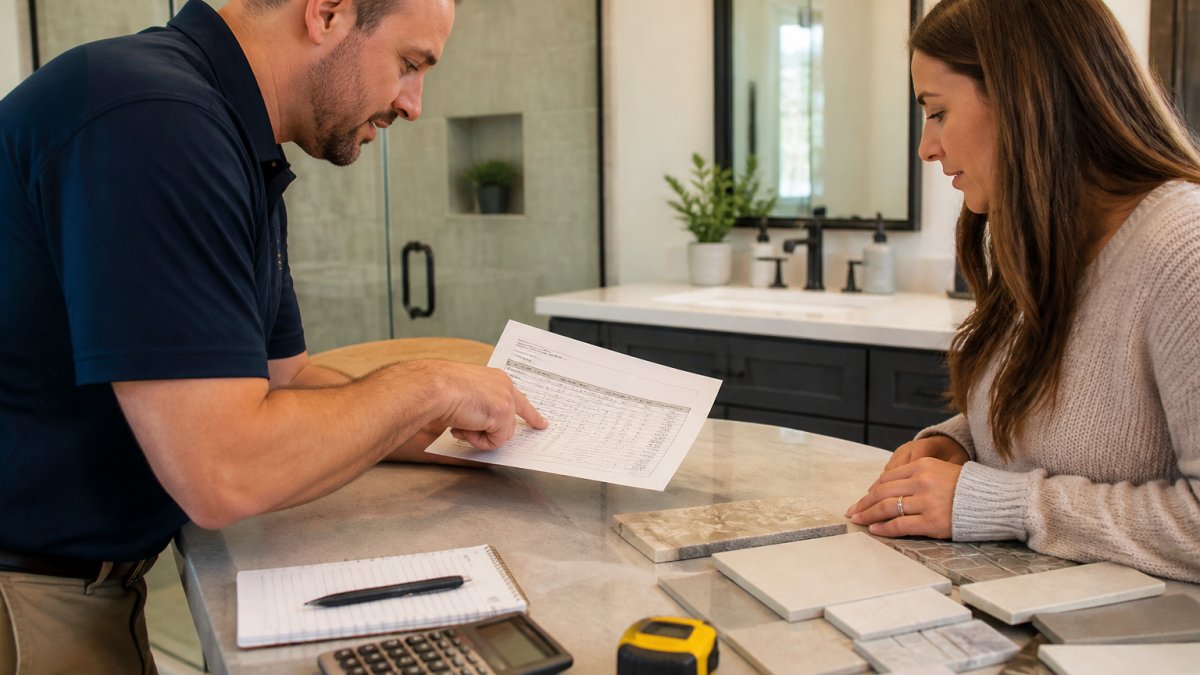
Most published breakdowns give you a percentage and stop, not enough to compare two estimates.
Assumptions for this example: 40-100 sq ft full bath; single vanity; tub-to-shower conversion; no layout change; midrange finishes; one licensed plumber and one licensed electrician; permit pulled; project completed in a single phase.
| Line Item | Share of Budget | Example on a $30,000 Total | What Drives the Number |
|---|---|---|---|
| Demolition and disposal | 5-10% | $1,500-$3,000 | Dumpster rental, haul-away fees, whether tile is set over a mortar bed |
| Rough plumbing | 8-15% | $2,400-$4,500 | Whether the drain and supply lines move; valve and shutoff replacement |
| Rough electrical | 5-10% | $1,500-$3,000 | New GFCI circuits, exhaust fan, dedicated vanity circuit, recessed lighting |
| Tile and waterproofing | 12-20% | $3,600-$6,000 | Wall prep, cement board or foam board, membrane, tile size and pattern |
| Fixtures and vanity | 10-20% | $3,000-$6,000 | Stock vs. custom cabinetry; toilet, sink, faucet, shower trim |
| Finishes (paint, trim, mirror, hardware) | 5-10% | $1,500-$3,000 | Paint grade, trim profile, mirror size, accessory package |
| Permits and inspections | 2-5% | $600-$1,500 | Jurisdiction fee schedule; number of inspections required |
| Contingency | 10-20% | $3,000-$6,000 | Age of home, prior water damage, code upgrades triggered by the scope |
Two things stand out. The hardest-to-predict line items, plumbing, electrical, and contingency, can together account for a third of the budget.
Why the Split Moves
Finish level moves the materials share most: a stock vanity and ceramic tile keep product costs contained, while custom cabinetry and natural stone push the same room into a different bracket.
Scope moves the labor share.
U.S. Bureau of Labor Statistics occupational data for construction trades shows that skilled trade availability affects scheduling and pricing in every market. When local trades are booked, labor costs rise and timelines stretch.
How to Use This Split When You Compare Bids
Ask each contractor to break their estimate into the same line items shown above. If one bid lumps "labor and materials" into a single number, you can't tell whether the difference is in the tile allowance, the plumbing scope, or the contingency. A bid that names its assumptions, square footage, fixture tier, layout changes, permit inclusion, is comparable; one that doesn't is a guess.
Bathroom Remodel Timeline 2026: How Schedule Affects Price
A bathroom remodel timeline in 2026 runs longer than most homeowners expect, and schedule pressure directly affects price. A cosmetic refresh may finish in two to three weeks, a midrange remodel commonly takes four to six weeks, and a full gut renovation often runs eight to twelve weeks once permits, inspections, and trade scheduling are factored in.
Rushing costs money: expedited material orders, overtime labor, and rushed inspections all carry premiums. Long projects also carry carrying costs, temporary housing, disrupted routines, and sometimes extended equipment rental.
How to Budget for a Bathroom Renovation: A Percentage-Based Framework
Budgeting works best when you assign percentages rather than fixed dollar amounts, because percentages scale with whatever your actual project turns out to be. Start with your total budget and allocate it like this:
- Construction and labor: 55-65%
- Materials and finishes: 20-25%
- Fixtures and vanity: 10-15%
Permits, Inspections, and Code-Compliance Costs
Permits and inspections are the costs homeowners forget. Most jurisdictions require a permit for plumbing relocation, electrical work, and structural changes, and inspections are scheduled at defined stages, typically rough-in before walls close and final after fixtures are set. Local building permit guidance from the U.S. Department of Housing and Urban Development explains how local code adoption works, and your city or county building department sets the actual fees and inspection schedule.
A few practical points about permits:
- Permit fees are usually calculated from project valuation, so a larger scope means a larger fee.
- Some jurisdictions require a licensed contractor to pull the permit; others allow a homeowner permit for owner-occupied work.
- Inspections are not optional. A failed rough-in inspection means opening walls again, which is a labor cost, not a materials cost.
Contingency Planning and Hidden-Condition Costs
Contingency is the line item that separates a budget from a wish. In a bathroom, hidden conditions are the rule, not the exception, because the room is wet by design and often decades old.
Common hidden conditions and what they cost:
- Water damage behind tile or under the tub. Rot in the subfloor or framing must be cut out and replaced before new tile goes down, a carpentry and materials cost that delays the tile trade.
- Mold. Remediation is a separate scope with its own containment and disposal requirements, and must be resolved before reconstruction.
- Outdated wiring. A circuit predating GFCI protection, or wiring without a ground, must be brought to code once walls are open, an electrical cost not in the original scope.
A practical contingency range is 10-20% of the total budget. The lower end fits a newer home with a recent renovation and no moisture history; the upper end fits a pre-1980s home, visible prior repairs, or walls not opened in decades.
Cosmetic Update vs. Full Gut: Why the Same Room Has Two Very Different Budgets
A scope-based comparison explains why two estimates for the same square footage can differ by a factor of three.
| Budget Line | Cosmetic Update | Midrange Remodel | Full Gut Renovation |
|---|---|---|---|
| Layout change | No | Rarely | Often |
| Plumbing | Fixture swap only | Some updates | Full rough-in to code |
| Electrical | Fixture swap only | New fan, some circuits | New circuits, GFCI, lighting plan |
| Walls opened | No | Sometimes | Yes, to studs |
| Subfloor repair | Unlikely | Possible | Likely |
| Permit required | Usually not | Often | Yes |
| Contingency needed | 5-10% | 10-15% | 15-20% |
| Typical duration | 2-3 weeks | 4-6 weeks | 8-12 weeks |
The takeaway isn't the dollar range, it's that the scope tier determines which line items exist at all. A cosmetic update has no rough plumbing line. A full gut has no way to avoid one.
Cost-Saving Trade-Offs and DIY vs. Professional Work
There are real savings available, but they come with real risk.
- Keep the layout. Not moving the toilet, sink, or shower drain avoids rough plumbing and the permit amendment that often comes with it, the single largest controllable saving in most bathroom projects.
- Reuse fixtures where they are sound. A toilet or vanity in good condition can be refinished or reused, but only if the fixture isn't the reason for the renovation.
- Do your own demolition. Demolition is unskilled labor, but the risk is damaging a drain line, supply line, or joist you didn't know was there, converting a saving into a repair.
Accessible and Water-Efficiency Upgrades: The Incremental Cost
Some upgrades are worth pricing before the walls close, because retrofitting later costs far more.
- Curbless shower. Eliminates the curb for step-free access. Requires a recessed or sloped subfloor and a linear drain, a framing and plumbing cost, not a finish cost.
- Grab bars and blocking. The bars are inexpensive; the cost is the blocking installed inside the wall before tile goes up. Adding it during a gut renovation is a small line item; adding it after tile means removing tile.
- Comfort-height toilet and lever handles. Minimal incremental cost, meaningful accessibility benefit.
Comparing Estimates and Choosing a Contractor
Three estimates on the same scope can differ widely, and the lowest number is rarely the best value.
| What to Compare | Why It Matters |
|---|---|
| Scope detail | Vague scopes hide exclusions that become change orders |
| Allowances | Low allowances produce mid-project price increases |
| Contingency | A contractor with no contingency plan shifts risk to you |
| Timeline | Unrealistic schedules signal underbid labor |
| Warranty | Written warranty terms protect you after final payment |
Consumer guidance on hiring contractors from the Federal Trade Commission recommends getting everything in writing, including the scope, payment schedule, and change-order process.
At Revo Kitchen and Bath, we build estimates line by line and walk homeowners through each assumption before work starts.
One more note on trades: U.S. Bureau of Labor Statistics occupational data for construction trades shows that skilled trade availability affects scheduling and pricing in every market.
Bathroom renovation pricing gets unpredictable the moment scope, hidden conditions, and schedule collide.
Frequently Asked Questions
What is the average cost of a bathroom remodel in 2026?
There is no single average that applies to every project. Bathroom renovation pricing depends on square footage, project scope, finish level, and your local labor market. A small cosmetic refresh sits at the low end, a midrange full remodel lands in the middle, and a high-end renovation with layout changes and custom features sits at the top. Always request a written, itemized estimate for your specific bathroom rather than relying on a national average.
How much should I budget for bathroom labor vs. materials?
As a planning assumption, labor and installation typically account for roughly 40 to 60 percent of a bathroom renovation budget, with materials, fixtures, and finishes making up the rest. That split shifts with finish level: high-end tile, custom vanities, and designer fixtures raise the material share, while simple layouts with stock products keep labor as the larger portion. Ask your contractor to break the estimate into labor and materials lines so you can see the actual ratio for your project.
Does a bathroom renovation increase home value in 2026?
A well-executed bathroom renovation can support resale value because buyers weigh updated, functional bathrooms heavily. The return depends on how closely your finishes match the neighborhood and how much you overspend relative to surrounding homes. Durable, waterproof wall solutions and modern, accessible showers tend to hold up better and photograph well, which helps at listing time. Treat value as a secondary benefit and prioritize a renovation you will actually enjoy.
What are the hidden costs of bathroom remodeling?
The most common hidden costs are what contractors find after demolition: rotted subfloor, water damage behind old tile, outdated wiring, or plumbing that does not meet current code. Permits and inspections add line items that homeowners often forget to budget for. A contingency fund of 10 to 20 percent of the project total is the standard way to absorb these surprises without derailing the budget.
How long does a typical bathroom renovation take?
Timelines vary with scope. A cosmetic refresh, such as new fixtures, paint, and flooring, may take one to two weeks. A midrange remodel with a new vanity, tile, and shower typically runs three to five weeks. A full gut renovation with layout changes, plumbing relocation, and electrical work can stretch to six to ten weeks or more, depending on permit and inspection schedules. Ask for a written schedule with milestones before work begins.
Is it cheaper to DIY or hire a professional for bathroom renovations?
DIY can reduce labor costs on tasks like demolition, painting, and simple fixture swaps, but bathrooms concentrate plumbing, electrical, and waterproofing work in a small space. Mistakes in those areas cause leaks, mold, and code violations that cost far more to fix than the original labor would have. Hiring licensed professionals for waterproofing, plumbing, and electrical work, and handling cosmetic tasks yourself, is usually the safer trade-off.
How do I compare bathroom renovation estimates fairly?
Compare estimates line by line, not by the bottom-line number. Check that each quote lists the same scope: demolition and disposal, plumbing updates, electrical work, tile and flooring, vanity and fixtures, and permits. Ask whether the price includes waterproofing materials and labor, since that is where cheap quotes cut corners. A lower bid that omits waterproofing or permits is not actually cheaper once those items are added back.
Should I plan a contingency for my bathroom renovation budget?
Yes. A contingency of 10 to 20 percent of the project total is standard practice because demolition regularly reveals conditions no one could see beforehand, such as subfloor damage, old plumbing, or wiring that does not meet code. Setting that money aside before the project starts keeps a surprise repair from forcing you to downgrade finishes or pause the job mid-renovation.